Key Takeaway
Active injury recovery relies on biomechanical principles to correct altered movement patterns, rebuild neuromuscular control, and restore full physical functionality. A Kelowna Kinesiologist designs evidence-based exercise interventions that target postural misalignments, muscle imbalances, and joint stabilization. This systematic approach transitions individuals from passive pain management to sustainable active rehabilitation, effectively preventing recurrent tissue strain.
Understanding Kinesiology and Active Rehabilitation
Kinesiology is the scientific study of human movement, mechanics, and anatomy applied to improve physical function, performance, and health. In the context of clinical injury recovery, active rehabilitation utilizes controlled physical movement and prescribed exercise to restore injured tissues to their pre-injury baseline.
The Definition and Scope of Kinesiology
Kinesiology encompasses the integration of biomechanics, human anatomy, exercise physiology, and motor control. Practitioners in this field analyze how structural forces act upon the musculoskeletal system during stationary and dynamic activities.
- Biomechanics: The study of mechanical laws relating to the movement or structure of living organisms.
- Functional Anatomy: The study of body structures relative to the performative demands of daily movement.
- Exercise Physiology: The examination of biological responses and adaptations to physical stress and therapeutic exercise.
- Motor Learning: The process through which the nervous system develops, refines, and retains movement patterns over time.
A Kelowna Kinesiologist utilizes these scientific disciplines to identify mechanical breakdowns and construct individualized active care plans.
Passive Therapy Versus Active Rehabilitation
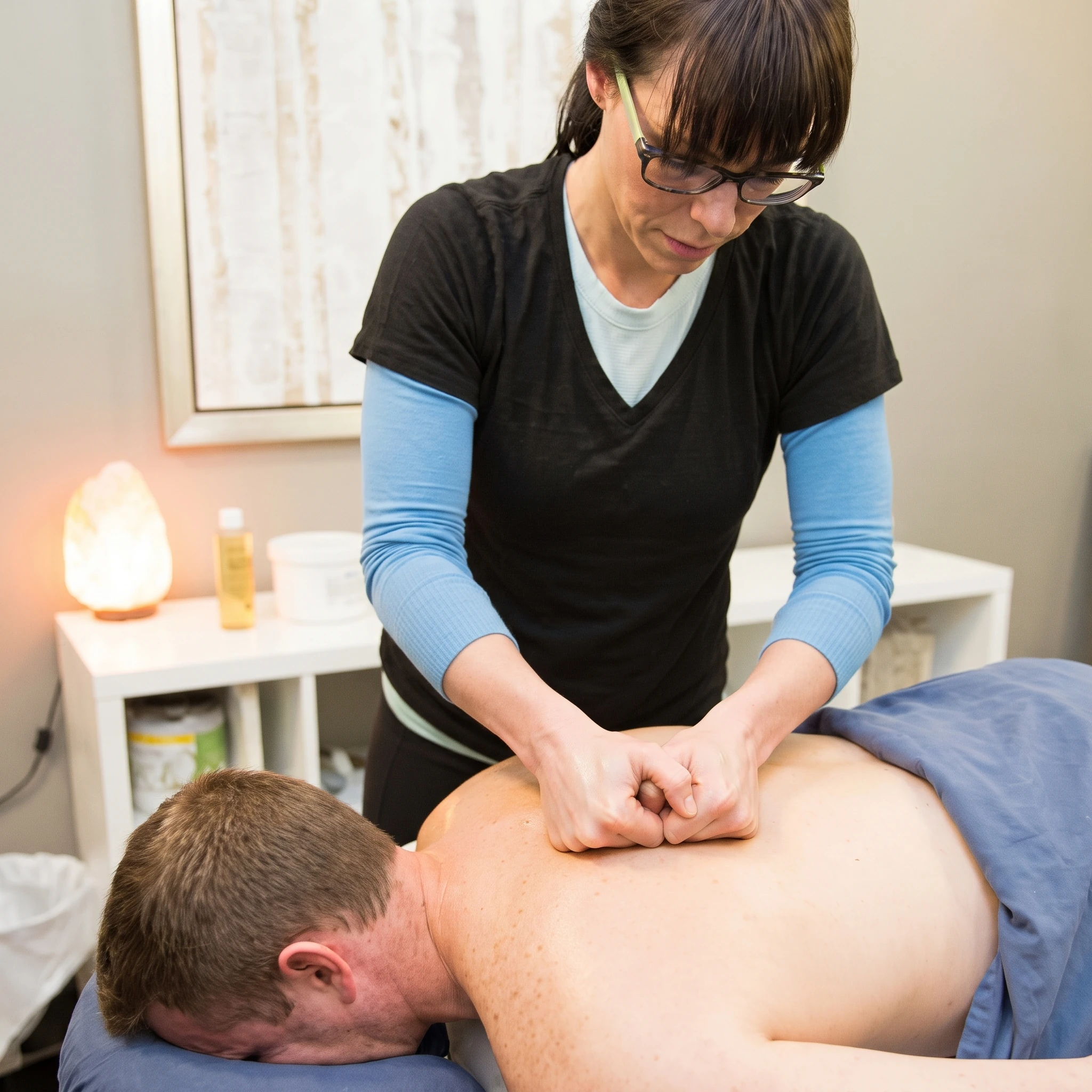
Passive therapy refers to clinical interventions where the patient receives manual manipulation, ultrasound, ice, or heat without active muscle engagement. Active rehabilitation involves guided, voluntary physical effort executed by the patient under professional instruction. While passive treatments reduce initial pain and tissue inflammation, active rehabilitation builds long-term physical resilience by strengthening muscle structures, enhancing ligament stability, and retraining movement coordination.
Biomechanical Assessment Protocols in Kinesiology
A biomechanical assessment is a structured evaluation procedure used to measure joint range of motion, muscle strength, postural alignment, and movement efficiency. This assessment forms the foundation for targeted exercise interventions.
Postural and Alignment Evaluation
Postural evaluation is the observational and quantitative measurement of body segment alignment relative to gravitational force lines. Physical trauma, repetitive strain, or prolonged sitting can create structural misalignments across the skeletal frame. During an evaluation, the kinesiologist measures structural variance in the following regions:
- Cervical and Thoracic Spine: Assessing anterior head carriage, hyperkyphosis, and shoulder girdle protracted states.
- Pelvic Girdle: Evaluating anterior or posterior pelvic tilt, lateral pelvic drops, and rotational deviations.
- Lower Extremities: Inspecting hip internal rotation, knee valgus alignment, and subtalar pronation or supination.
Identifying structural misalignments allows the kinesiologist to isolate regions subject to excessive shear or compressive forces.
Dynamic Movement Screening and Muscle Imbalance Identification
Dynamic movement screening is an active testing procedure that evaluates how joints and muscles perform during multi-plane functional tasks. Tests such as overhead squats, single-leg steps, and trunk stability pushes reveal compensation patterns.
Muscle imbalances occur when one muscle group becomes chronically tight or overactive while its antagonist muscle group becomes lengthened and inhibited. A Kelowna Kinesiologist categorizes these imbalances to determine which muscle groups require targeted release and which require isolated strengthening.
The Phases of Long-Term Injury Rehabilitation
Long-term injury rehabilitation is a phased process that transitions tissue from acute inflammation to full functional adaptation. Progression depends on criteria-based milestones rather than arbitrary timeframes.
Phase 1: Acute Pain Mitigation and Mobility Restoration
Acute mobility restoration focuses on reducing joint stiffness, managing pain, and restoring gentle, pain-free range of motion. In this initial phase, high-intensity loading is avoided to protect healing soft tissues.
- Passive and Active-Assisted Range of Motion: Gentle joint mobilizations through pain-free arcs.
- Isometric Muscle Contractions: Low-intensity muscle activations that prevent atrophy without moving the joint.
- Hydrotherapy Applications: Aquatic exercise therapy designed to unweight joints and allow low-impact mobility.
Phase 2: Neuromuscular Retraining and Structural Strengthening
Neuromuscular retraining is the re-establishment of effective neural communication between the central nervous system and target muscle groups. Following an injury, pain signals often inhibit muscle firing patterns.
This phase introduces resistance training to rebuild structural tissue capacity. Closed-kinetic-chain exercises – where the distal limb is anchored to a fixed surface – are deployed to enhance joint stability and load distribution.
Phase 3: Functional Integration and Ergonomic Conditioning
Functional integration is the application of strength and mobility adaptations to multi-joint movements that mirror daily life, occupational tasks, or sport-specific demands.
The kinesiologist prescribes movement patterns involving multi-planar lifting, pushing, pulling, and rotation. Ergonomic instruction is provided to modify workplace environments, ensuring post-rehabilitation habits do not reproduce original mechanical stresses.
Core Strategies Utilized by a Kelowna Kinesiologist
A Kelowna Kinesiologist implements systematic strategies to rebuild functional movement and prevent recurrent injury. These strategies target muscle recruitment, sensory feedback, and full-body movement coordination.
Corrective Exercise Prescription
Corrective exercise prescription is the systematic selection of targeted movements engineered to address specific physical deficits identified during assessment.
Assessment -> Deficit Identification -> Exercise Selection -> Supervised Execution -> Progress Re-Evaluation
Primary categories of corrective exercise include:
- Inhibition and Lengthening: Utilizing self-myofascial techniques and static stretching to reduce tension in overactive muscles.
- Activation Exercises: Isolating underactive or weak muscles using low-load isometric or concentric contractions.
- Integration Exercises: Combining activated muscles into multi-joint functional movements to restore proper motor sequences.
Proprioceptive and Balance Retraining
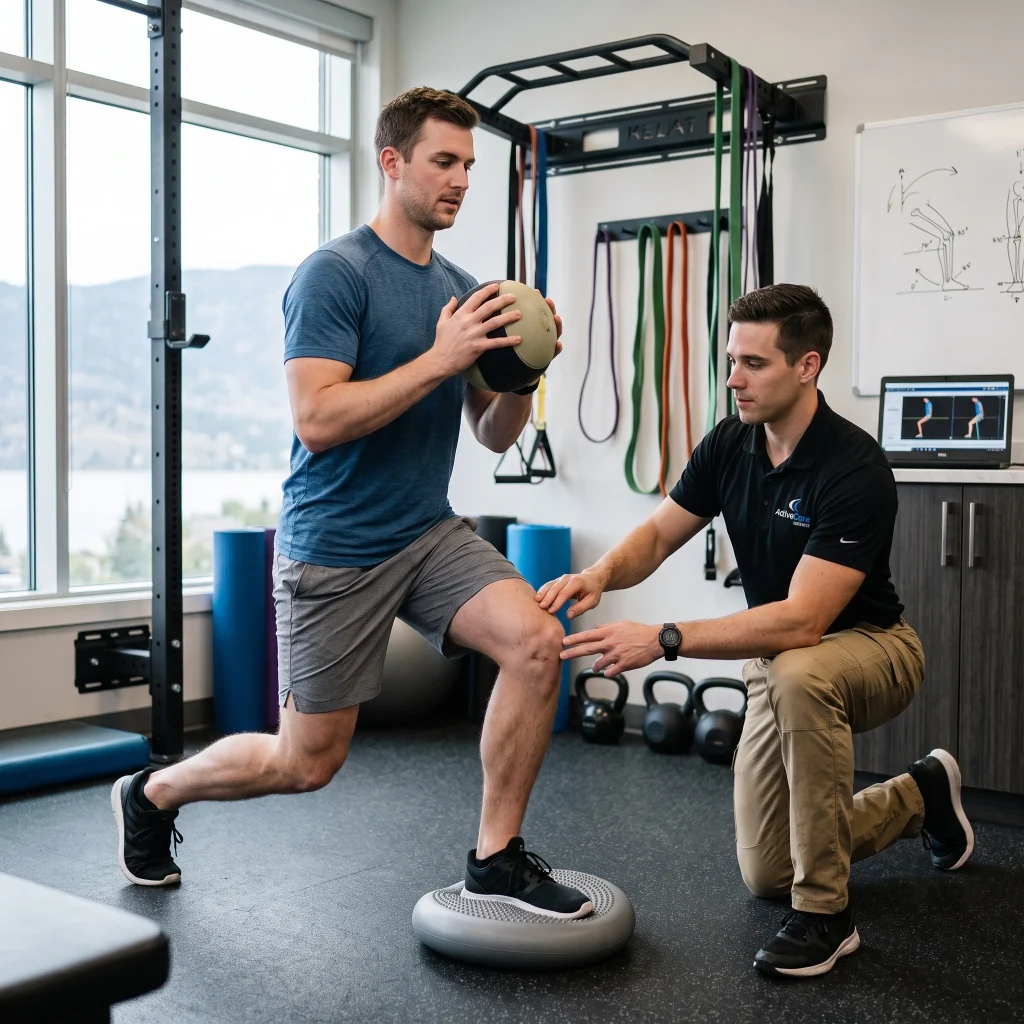
Proprioception is the sensory ability of the body to perceive its position, motion, and spatial orientation within its environment. Joint capsule or ligament damage impairs mechanoreceptors, leading to joint instability. Balance retraining uses unstable surfaces, single-leg stances, and visual disruption drills to rebuild reflex responses and dynamic joint stability.
Kinetic Chain Re-education
Kinetic chain re-education is the optimization of sequential body segment interactions to transfer energy efficiently across the musculoskeletal system. An injury in one segment of the kinetic chain – such as an ankle strain – forces adjacent segments like the knee and hip to absorb abnormal forces. Kinesiologists retrain the entire kinetic chain to ensure forces distribute evenly throughout the body during gait, lifting, and overhead movements.
Comparative Overview of Active Rehabilitation Methods
The table below outlines primary active rehabilitation methods utilized in kinesiology, detailing their physiological focus, targeted outcomes, and practical applications.
| Method | Physiological Focus | Primary Outcome | Application Example |
| Isometric Loading | Static force production without joint movement | Pain reduction and initial strength preservation | Wall sits, sub-maximal glute bridges |
| Eccentric Training | Controlled muscle lengthening under tension | Tendon remodelling and tissue tensile strength | Slow eccentric calf raises, tempo squats |
| Proprioceptive Drills | Mechanoreceptor activation and reflex response | Joint stabilization and balance enhancement | Single-leg balance on foam pad |
| Core Stabilization | Deep abdominal and paraspinal muscle co-contraction | Spinal stiffness and pelvic control | Bird-dog, dead bug progressions |
| Functional Movement | Multi-planar compound movement coordination | Return to daily activities and sports | Resistance band deadlifts, step-ups |
Frequently Asked Questions About Kinesiology and Injury Recovery
What is the role of a Kelowna Kinesiologist in injury recovery?
A Kelowna Kinesiologist evaluates human movement, identifies structural misalignments or muscle imbalances, and designs customized exercise rehabilitation programs. Their role is to transition patients from acute pain management to full daily functionality through active movement therapy.
How does active rehabilitation differ from traditional physical therapy?
Physical therapy often incorporates hands-on manual adjustments, modalities, and initial pain management techniques during early injury stages. Active rehabilitation focuses primarily on patient-driven exercise, biomechanical correction, strength building, and long-term functional retraining.
When should an injured individual transition from rest to kinesiology therapy?
An individual should transition to kinesiology therapy once acute tissue inflammation subsides and basic range of motion is achieved without severe pain. Early introduction of active rehabilitation prevents muscle atrophy, joint stiffness, and compensatory movement patterns.
What specific exercises are included in a kinesiology program?
A kinesiology program includes corrective stretching, isolated muscle activation drills, core stabilization exercises, balance retraining, and multi-joint functional strength movements tailored to the specific injury.
How long does a typical kinesiology rehabilitation program take?
A kinesiology program typically ranges from 8 to 12 weeks, depending on the severity of the injury, baseline physical fitness, and individual adherence to prescribed home exercise protocols.