Key Takeaway: Structured Kelowna Massage Therapy delivered by a Registered Massage Therapist in Kelowna provides evidence based soft tissue manipulation designed to treat mechanical dysfunction, accelerate tissue repair, and restore joint mobility. Clinical treatment plans target deep muscular hypertonicity, decrease localized vascular resistance, reduce pain signaling, and resolve chronic biomechanical overload caused by repetitive physical labor.
Defining Clinical Soft Tissue Management in Musculoskeletal Health
Clinical soft tissue management refers to the targeted manual manipulation of non-calcified human tissues, including muscles, tendons, fascia, and ligaments. Unlike general spa treatments aimed primarily at stress relief, clinical manual therapy addresses physiological dysfunction, anatomical misalignments, and soft tissue restrictions resulting from microtrauma, acute injury, or repetitive strain.
At Active Care Health in Kelowna, British Columbia, clinical soft tissue treatment operates as an integral component of multidisciplinary rehabilitation. Orchard workers and individuals undergoing sustained physical exertion frequently experience biomechanical stress, localized ischemia, and muscular fatigue. Clinical intervention focuses on mechanical target outcomes:
- Breaking up intra-muscular and inter-fascial adhesions.
- Modulating central and peripheral nervous system nociception.
- Restoring full range of motion within affected joint complexes.
- Lowering passive muscular tension to prevent structural compensations.
Anatomical Impacts of Repetitive Strain on Orchard Workers
Orchard manual labor requires sustained upper extremity elevation, heavy load bearing, continuous trunk rotation, and repetitive gripping. These movement patterns subject the musculoskeletal system to persistent mechanical overload, leading to cumulative microtrauma within soft tissue structures.
Pathophysiology of Microtrauma and Hypertonicity
Continuous muscular contraction restricts local arteriolar blood flow, creating localized tissue hypoxia. Lactic acid and inflammatory metabolic byproducts accumulate in the intramuscular environment, stimulating nociceptors and generating localized pain. In response, the nervous system increases motor unit firing, creating a continuous state of muscular contraction known as hypertonicity.
Fascial Restrictions and Adhesion Formation
Sustained stress alters the extracellular matrix of fascial tissue. Fibroblasts increase collagen deposition, causing adjacent fascial layers to bind together. These cross-linked collagen fibers form dense adhesions, restricting smooth sliding mechanics between muscle bellies and sliding fascial planes. This mechanical restriction compromises power output, decreases mobility, and increases susceptibility to tendonitis and joint obstruction.
Clinical Mechanisms of Kelowna Massage Therapy
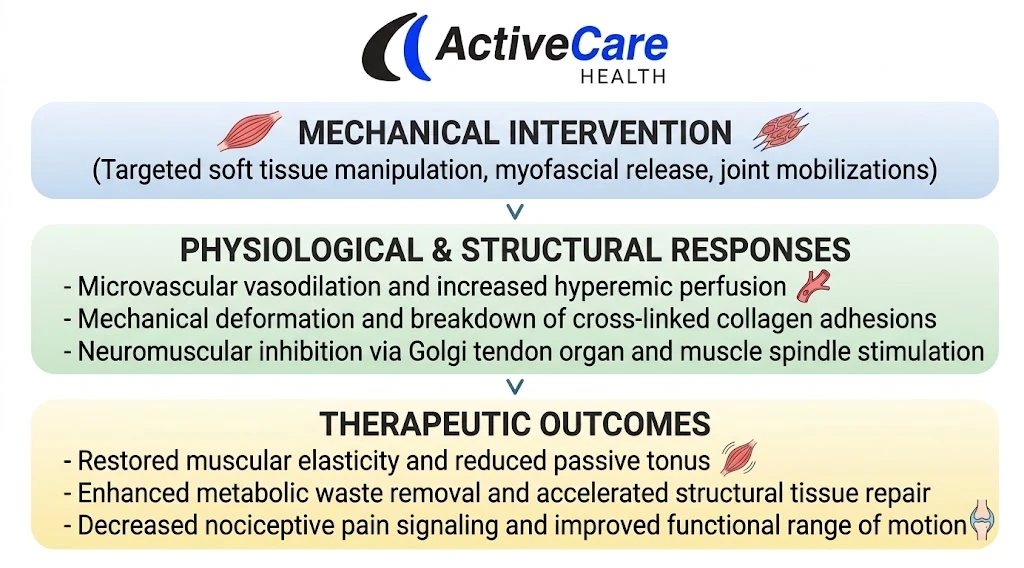
A treatment plan designed by a Registered Massage Therapist Kelowna utilizes specific mechanical forces to alter soft tissue architecture, manipulate fluid dynamics, and influence neurophysiology.
Hyperemic Perfusion and Fluid Dynamics
Targeted compression and petrissage strokes exert mechanical pressure on local vascular networks. This manual force pushes stagnant metabolic waste out of capillary beds, allowing fresh, oxygenated arterial blood to flush the treated tissues upon release. Increased localized blood flow supplies essential amino acids and oxygen necessary for cellular repair while expediting the clearance of inflammatory mediators.
Neuromuscular Inhibition and Trigger Point Resolution
Clinical pressure applied directly to myofascial trigger points stimulates Golgi tendon organs and muscle spindle receptors. This stimulation signals the central nervous system to downregulate alpha motor neuron activity, forcing the chronically contracted muscle fibers to relax. As a result, resting muscle tone drops, relieving mechanical tension on attached tendons and bony insertions.
Key Clinical Modalities Utilized by a Registered Massage Therapist Kelowna
A Registered Massage Therapist in Kelowna utilizes specialized evidence-based manual modalities based on individual functional assessments:
- Myofascial Release: Sustained low-load stretch applied to restricted fascial layers to eliminate tension and restore fluid shear movement between tissues.
- Trigger Point Therapy: Sustained ischemic compression applied to hyperirritable spots in skeletal muscle to deactivate active pain generator sites.
- Deep Tissue Manipulation: Slow, focused manual strokes applied perpendicular or parallel to deep muscle fibers to disrupt dense scar tissue and chronic cross-linked adhesions.
- Active and Passive Mobilization: Combining manual soft tissue pressure with passive or active range of motion to restore healthy sliding mechanics between overlapping muscle groups.
- Neuromuscular Therapy: Specialized pressure protocols designed to balance nervous system output, decrease pain sensitivity, and correct altered movement patterns.
Comparing General Spa Massage and Clinical Kelowna Massage Therapy
| Characteristic | General Spa Massage | Clinical Kelowna Massage Therapy |
| Primary Objective | General stress reduction and superficial relaxation. | Pathological tissue treatment, pain reduction, and functional restoration. |
| Diagnostic Assessment | None; general application of light-to-medium pressure. | Comprehensive orthopedic testing, movement analysis, and palpation. |
| Practioner Standard | Unregulated bodywork or spa technician. | Registered Massage Therapist Kelowna governed by provincial regulatory standards. |
| Treatment Customization | Standardized full-body routine. | Targeted, symptom-specific treatment plans tailored to anatomical dysfunction. |
| Tissue Layers Targeted | Superficial skin and high-level muscular structures. | Deep muscular layers, intermuscular septa, joint capsules, and deep fascia. |
| Rehabilitative Integration | Standalone personal service. | Coordinated with Chiropractic Care, Kinesiology, and Physical Rehabilitation. |
Integrating Soft Tissue Care with Multidisciplinary Healthcare
Optimal recovery from severe physical exertion or chronic strain requires a comprehensive treatment strategy. Soft tissue injuries often coexist with joint dysfunction, muscular imbalances, and altered biomechanical movement patterns.
At Active Care Health, clinical care plans coordinate Kelowna Massage Therapy with Chiropractic interventions, Registered Kinesiology, and Cold Laser Therapy. While Chiropractic adjustments resolve joint misalignments and structural obstructions, targeted soft tissue manipulation reduces the surrounding muscular hypertonicity that often pulls joints back out of alignment. Kinesiology reinforces these corrections through functional exercise, ensuring sustained functional recovery for individuals in demanding physical environments.
Frequently Asked Questions
How does clinical soft tissue manipulation differ from relaxation massage?
Clinical soft tissue manipulation focuses on treating specific anatomical dysfunctions, muscular adhesions, and chronic strain patterns through detailed assessments and targeted clinical techniques. Relaxation massage utilizes standardized, light-to-medium superficial pressure designed primarily for short-term stress reduction without addressing underlying musculoskeletal pathology.
How many sessions of Kelowna Massage Therapy are required to resolve chronic strain?
The required number of sessions depends on tissue chronicity, injury severity, and ongoing physical workplace demands. Acute soft tissue strain may show significant improvement within three to five targeted treatments, whereas chronic strain patterns resulting from daily repetitive physical labor often require ongoing maintenance care to preserve structural integrity.
Can targeted soft tissue work reduce mechanical nerve irritation?
Yes – hypertonic muscle bellies and tight fascial bands can compress peripheral nerves as they pass through anatomical tunnels. By releasing hypertonicity and reducing fascia-induced entrapment, clinical soft tissue treatment decreases localized pressure on nervous structures, relieving associated tingling, numbness, and referred pain.
What should an individual expect during an initial clinical consultation?
An initial clinical visit includes a detailed medical history review, objective postural analysis, range of motion testing, and selective orthopedic palpation. The therapist uses these anatomical findings to construct an individualized treatment plan targeted directly at identified soft tissue restrictions and mechanical obstructions.
How does soft tissue management aid in preventing workplace overuse injuries?
Regular soft tissue manipulation maintains fascia elasticity, prevents microvascular ischemia, and stops microtrauma from developing into dense, restrictive scar tissue. By maintaining proper resting muscle length and joint mechanics, clinical care reduces systemic compensation patterns and lowers overall injury vulnerability during repetitive tasks.