
Key Takeaway: Proactive joint care supports structural integrity and spinal biomechanics through non-invasive techniques across all stages of life. Experienced Kelowna chiropractors at Active Care Health utilize precise spinal checkups to correct biomechanical obstructions, mitigate occupational physical stress, optimize neuromuscular communication, and restore joint mobility, helping individuals maintain active lifestyles without reliance on surgical procedures or pharmaceutical intervention.
The Biomechanical Demands of Occupational Manual Labor
Occupational manual labor, particularly agricultural work such as orchard harvesting, subjects the human musculoskeletal system to repetitive physical stress, sustained mechanical loading, and extreme joint ranges of motion. Understanding the physiological impact of these movement patterns is critical for preventing chronic mechanical wear and structural dysfunction.
Kinetic Chain Strain in Agricultural Work
Agricultural labor involves continuous overhead reaching, heavy lifting, lateral trunk flexion, and awkward spinal rotation. These repetitive motions place substantial compressive and shear loads on the intervertebral discs and peripheral joints.
- Microtrauma Accumulation: Repeated physical tasks cause microscopic tears in tendon fibers, muscular tissue, and capsular ligaments. Over time, this microtrauma triggers localized inflammatory responses and tissue remodeling.
- Spinal Obstructions: Structural misalignments or mechanical obstructions within the facet joints alter normal vertebral motion segments. These obstructions disrupt joint proprioception and force adjacent spinal segments to compensate, accelerating degenerative wear.
- Asymmetrical Joint Loading: Carrying heavy harvest buckets, standing on uneven orchard terrain, and operating mechanical equipment generate asymmetric torque through the pelvis and lumbar spine, resulting in sacroiliac joint dysfunction.
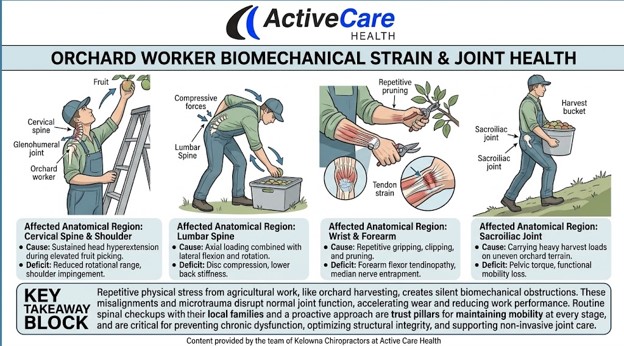
Common Repetitive Strain Manifestations
| Affected Anatomical Region | Underlying Mechanical Cause | Primary Functional Deficit |
| Cervical Spine | Sustained head hyperextension during elevated fruit picking | Reduced rotational range of motion, upper radiation pain |
| Lumbar Spine | Axial loading combined with lateral flexion and rotation | Intervertebral disc compression, lower back stiffness |
| Glenohumeral Joint | Overhead arm elevation while supporting harvest loads | Impingement of soft tissue structures, rotator cuff strain |
| Wrist & Forearm | Repetitive gripping, clipping, and pruning motions | Forearm flexor tendinopathy, median nerve entrapment |
Proactive Chiropractic Interventions for Spinal and Peripheral Joint Health
Proactive chiropractic care focuses on preserving joint mobility, optimizing nervous system function, and preventing cumulative structural breakdown. Rather than addressing symptoms solely after significant tissue damage occurs, routine evaluations identify silent biomechanical aberrations early.
Mechanisms of Conservative Spinal Manipulation
High-velocity, low-amplitude (HVLA) thrusts and gentle low-force techniques restore physiological motion to restricted joint complexes.
- Facet Joint Decompression: Manual adjustments separate joint surfaces briefly, releasing trapped synovial meniscoids and normalizing intra-articular pressure.
- Neuromuscular Reflex Modulation: Rapid stretch reflexes induced by an adjustment inhibit hypertonic paraspinal muscles, breaking the chronic pain-spasm-pain cycle.
- Proprioceptive Resetting: Joint mobilization stimulates mechanoreceptors within the joint capsule, overriding nociceptive (pain) signaling to the central nervous system.
Targeted Techniques Utilized at Active Care Health
The clinical team at Active Care Health in Kelowna applies specific, evidence-informed manual methodologies tailored to the physical demands of each patient.
- Soft Tissue Mobilization: Focused therapy targeting myofascial adhesions, reducing tightness in strained tendons and supporting peripheral joint recovery.
Structural Health Maintenance Across Every Stage of Life
Spinal alignment and joint mechanics change significantly across an individual’s lifespan. Proactive care adapts to these physiological shifts to maintain systemic function and functional independence.
Paediatric and Adolescent Joint Integrity
Developing skeletal systems experience unique mechanical stressors from growth spurts, postural habits, and athletic participation. Maintaining optimal spinal alignment during these developmental windows ensures balanced muscular development and correct postural biomechanics.
Adult Ergonomics and Occupational Protection
Working adults face structural stress from either prolonged sedentary posture or heavy labor. Chiropractic interventions focus on normalizing axial loading, reducing occupational microtrauma, and enhancing core kinetic stability to prevent acute performance loss.
Geriatric Mobility and Degeneration Management
Aging joint structures undergo cartilage thinning, osteophyte formation, and loss of disc height. Gentle joint mobilization maintains articular lubrication, preserves functional range of motion, and reduces fall risk by preserving postural equilibrium.
Functional Strategies to Prevent Occupational Strain
In addition to formal chiropractic checkups, implementing functional ergonomic strategies reduces the daily mechanical load placed on the musculoskeletal system during physical labor.
- Implement Proper Lifting Mechanics: Always bend at the knees and hips rather than rounding the lumbar spine. Keep heavy objects close to the center of gravity to minimize lumbar shear force.
- Utilize Dynamic Warm-Up Routines: Perform active joint mobility exercises for the shoulders, spine, and hips prior to beginning physical labor to increase synovial fluid circulation.
- Alternate Load Positions: Change the placement of tool belts, harvest bags, and equipment regularly to prevent asymmetrical muscle firing and pelvic torque.
- Integrate Micro-Breaks: Pause periodically to extend the spine and perform counter-stretches, relieving sustained end-range mechanical stress on spinal ligaments.
Frequently Asked Questions
How do spinal misalignments impact overall joint mechanics?
Spinal misalignments, or mechanical obstructions, alter normal joint movement patterns. When one segment fails to move correctly, adjacent joints undergo excessive strain to compensate, leading to asymmetric wear, joint capsule inflammation, and localized muscular spasms.
Is chiropractic care suitable for individuals who perform heavy physical labor?
Yes. Individuals performing heavy physical labor routinely experience high spinal compressive loads and repetitive microtrauma. Chiropractic care restores full joint range of motion, decreases hypertonicity in overused muscles, and assists in preventing overuse injuries.
What is the difference between acute injury treatment and proactive joint maintenance?
Acute injury treatment focuses on reducing immediate pain and inflammation following a specific trauma. Proactive joint maintenance identifies biomechanical restrictions and functional deficits early to prevent structural breakdown and optimize long-term mobility.
What non-invasive techniques are used during a chiropractic checkup?
Chiropractors utilize physical evaluations, joint palpaion, gait assessments, manual adjustments, instrument-assisted low-force impulses, soft tissue release, and targeted rehabilitation exercises.
How frequently should an individual receive a chiropractic evaluation?
Evaluation frequency depends on individual physical demands, occupational strain, spinal history, and current structural health. A practitioner establishes a customized schedule based on clinical findings to maintain structural alignment and functional joint capacity.