Key Takeaway
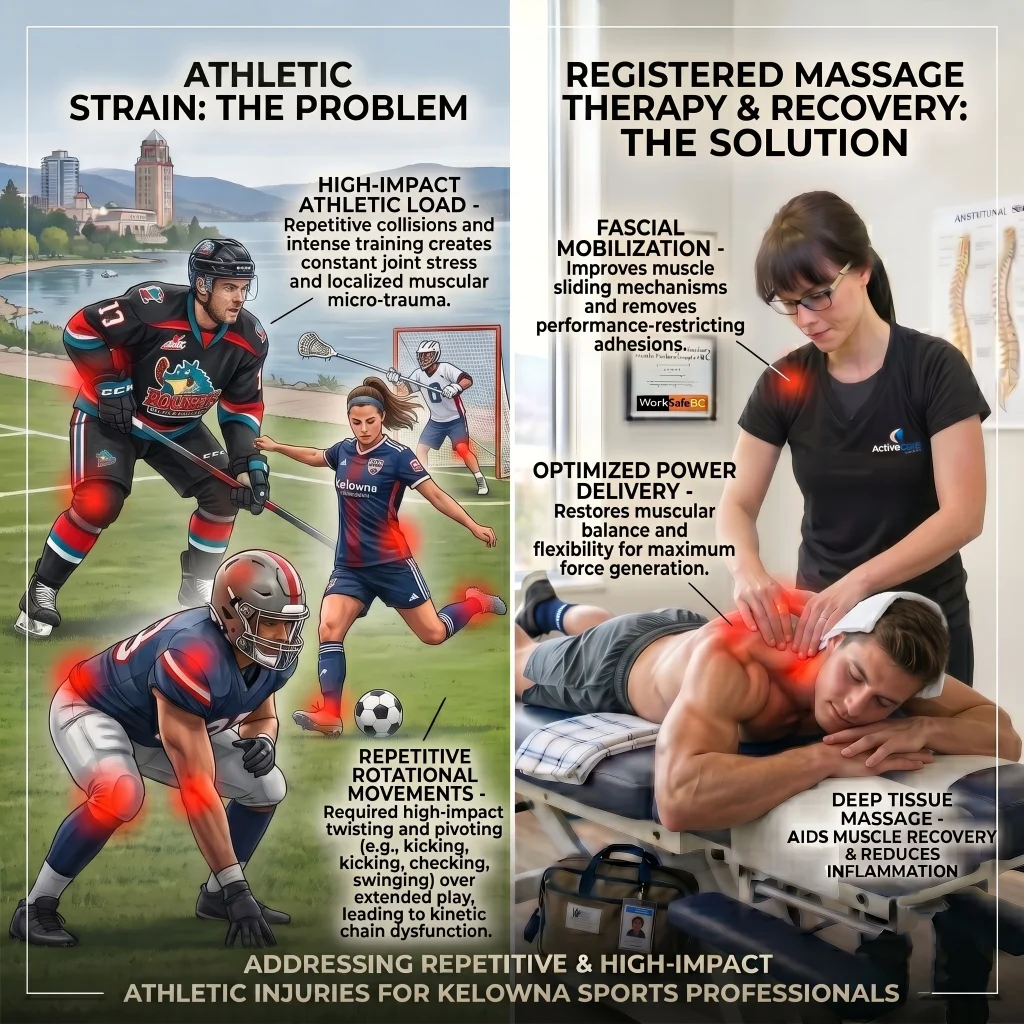
High intensity athletic training causes microscopic tears in muscle fibers and tightens fascial networks, which restricts physical performance and limits power output. Sports massage techniques applied by a professional registered massage Therapist in Kelowna improve muscular balance, break down fibrous scar tissue, and increase flexible power delivery. This specialized therapy accelerates tissue recovery, reduces injury risks, and optimizes biomechanical efficiency for competitive athletes.
Muscular Strain and Micro-Tears in High Intensity Training
High intensity physical training forces skeletal muscles to operate near their maximum physiological limits. This level of exertion routinely induces microscopic damage within the contractile units of the muscle tissue.
The Mechanics of Micro-Tears
During eccentric muscle contractions – where a muscle elongates under a load – the mechanical stress places severe tension on individual muscle fibers. This tension causes microscopic tears across the sarcolemma, which is the cell membrane of the muscle fiber. The disruption of these structural proteins initiates an inflammatory response. This biological process is necessary for tissue adaptation and growth, but it temporarily reduces the structural integrity and force production capabilities of the muscle group.
Physiological Symptoms of Tissue Damage
The primary manifestation of this microscopic structural disruption is delayed onset muscle soreness. This condition typically peaks between twenty-four and seventy-two hours after strenuous exercise. The accumulation of metabolic waste products and the influx of fluid into the interstitial spaces create localized pressure. This pressure stimulates nociceptors, which are the pain receptors in the tissue, resulting in the following physiological changes:
- A measurable reduction in joint range of motion.
- A decrease in localized muscular power output and peak torque.
- An increase in localized muscle guarding and resting tension.
- Altered biomechanical movement patterns to compensate for discomfort.
Fascial Networks and Performance Restriction
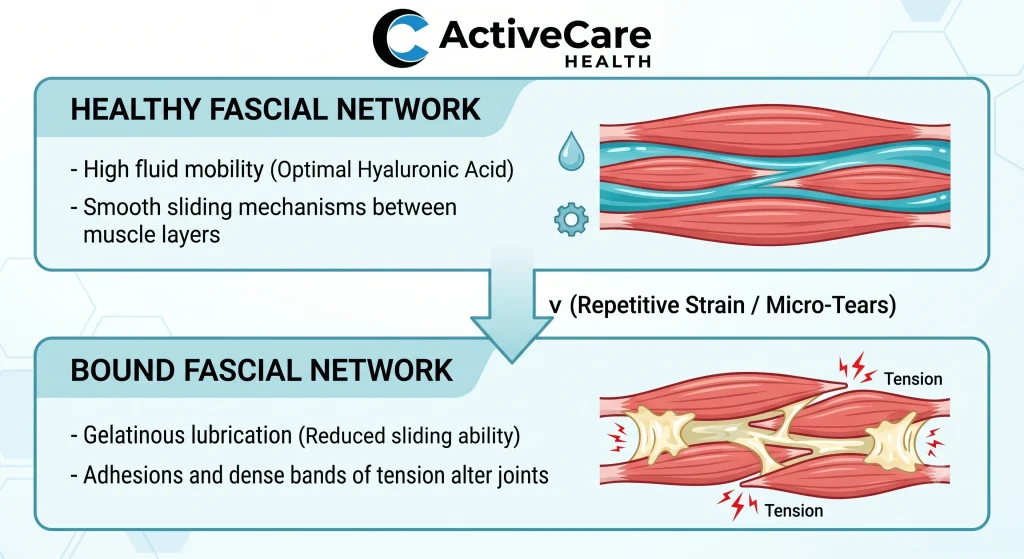
Fascia is a continuous web of dense collagenous connective tissue that surrounds every muscle, bone, nerve, and organ in the human body. It provides structural support and allows separate muscle groups to slide smoothly past one another during complex movements.
Fascial Binding and Restrictions
When tissues experience repetitive strain or localized inflammation from intense training, the fascial layers lose their natural lubrication. The hyaluronic acid between the layers can become thick and gelatinous, causing the fascial sheets to adhere to each other. This binding restricts the natural sliding mechanism of the muscles, creating dense bands of tension that limit flexibility and alter joint mechanics.
Impact on Athletic Power Delivery
Restricted fascia acts like a tight binding around a muscle group, which directly reduces athletic efficiency. When the fascial network is stiff, the muscle must expend more metabolic energy simply to overcome the internal resistance of its own surrounding tissues. This restriction directly alters the relationship between muscle tension and length, which prevents the athlete from achieving maximum power delivery during explosive movements.
Sports Massage Techniques for Muscular Balance
Clinical manual therapy utilizes specific, targeted inputs to address the structural imbalances caused by intense physical training. Practitioners utilize systematic protocols to restore tissue length and improve baseline circulation.
Myofascial Release
Myofascial release involves the application of sustained, low-load manual pressure into fascial restrictions. The practitioner engages the tissue barrier and holds the pressure to allow the collagenous matrix to elongate. This technique alters the physical state of the fascial ground substance, converting it from a thick gel to a more fluid state, which successfully eliminates adhesions.
Deep Tissue Protocols
Deep tissue manual therapy targets the deeper layers of muscle architecture and connective tissue. The strokes are slower and the pressure is more concentrated across the grain of the muscle fibers. This technique aims to release chronic muscle guarding, reduce localized hypertonicity, and restore a neutral resting length to overworked muscle groups.
| Technique | Primary Target | Physiological Mechanism |
| Myofascial Release | Fascial layers and ground substance | Elongates collagen fibers, fluidizes ground substance |
| Deep Tissue Therapy | Deep muscle layers, chronic hypertonicity | Releases localized guarding, restores resting tissue length |
| Trigger Point Therapy | Neuromuscular junctions, tight nodules | Deactivates hypersensitive spots, restores blood flow |
Breaking Down Scar Tissue and Fibrosis
Chronic repetitive strain and poorly healed micro-tears lead to the formation of dense, chaotic collagen deposits known as scar tissue or fibrosis. This tissue lacks the elasticity and organized structure of healthy muscle fibers.
The Formation of Adhesions
When muscle fibers tear, the body deposits random strands of collagen to quickly patch the structural gaps. Without manual intervention or precise movement, these strands bind together in a disorganized fashion, forming adhesions. These adhesions anchor muscle fibers to neighboring structures, which severely disrupts the uniform contraction of the muscle unit.
Mechanical Breakdowns of Fibrosis
Targeted manual therapy applies focused friction directly to these areas of fibrous accumulation. This mechanical stress helps break down the random cross-links of collagen. By disrupting these non-functional bonds, manual therapy encourages the body to reabsorb the excess fibrous tissue and replace it with more pliable, linear collagen structures.
Increasing Flexible Power Delivery
The ultimate goal of clinical manual therapy for competitive athletes is the optimization of the length-tension relationship within skeletal muscles. This optimization allows for maximum force generation throughout the full range of motion.
Neuromuscular Facilitation
Manual therapy stimulates specific mechanoreceptors embedded within the muscles and tendons, including the Golgi tendon organs and muscle spindles. The stimulation of these receptors sends inhibitory signals to the central nervous system, which reduces the baseline tone of overactive muscles. This neurological resetting allows the muscle to lengthen without triggering a protective contraction.
Optimizing Biomechanical Efficiency
When muscles and fascial networks are free from structural obstructions and misalignments, the skeleton can move through its precise anatomical trajectories. This structural efficiency provides several distinct advantages for athletes:
- It maximizes the distance over which a muscle can accelerate a load.
- It improves the storage and release of elastic energy within tendons.
- It reduces the metabolic cost of movement by eliminating internal tissue drag.
- It balances joint forces to prevent asymmetrical wear and chronic injuries.
Integrating Manual Therapy Into Training Regimens
To maximize the benefits of manual therapy, athletes must integrate these clinical treatments systematically into their broader training schedules.
Pre-Event Versus Post-Event Protocols
The timing of manual therapy significantly influences its physiological impact. Pre-event protocols focus on light, brisk techniques that stimulate blood flow and enhance neuromuscular excitability without inducing deep tissue fatigue. Post-event protocols prioritize slow, deep strokes that promote lymphatic drainage, reduce nervous system arousal, and accelerate the clearance of metabolic cellular debris.
Long-Term Maintenance and Prevention
Consistent application of manual therapy helps manage minor tissue stresses before they develop into debilitating injuries. Regular treatments maintain optimal fascial mobility and muscle balance throughout a demanding competitive season. This proactive approach ensures that athletes can sustain high-volume training blocks without experiencing a decline in mechanical efficiency.
Athletes seeking professional care can access services such as Kelowna Massage Therapy to address these specific physiological requirements.
Frequently Asked Questions
How does sports massage differ from standard relaxation massage?
Sports massage focuses on specific anatomical structures, clinical outcomes, and biomechanical performance. It utilizes advanced techniques such as myofascial release, trigger point therapy, and deep friction to address specific tissue restrictions, scar tissue, and muscular imbalances caused by intense physical activity. Relaxation massage primarily targets general stress reduction and superficial circulatory stimulation.
How soon after a high-intensity workout should an athlete receive treatment?
Light recovery protocols that focus on lymphatic drainage and gentle stretching can be applied immediately after a workout. Deep tissue interventions designed to address scar tissue and severe fascial binding are typically most effective when performed twenty-four to forty-eight hours after intense training, allowing initial acute muscular inflammation to subside.
Can manual therapy directly improve an athlete’s power output?
Yes. By releasing fascial restrictions and restoring optimal resting length to hypertonic muscles, manual therapy normalizes the length-tension relationship of the contractile units. This reduction in internal tissue resistance allows the musculoskeletal system to generate and transfer force more efficiently, which increases flexible power delivery.
How many sessions are required to resolve chronic scar tissue adhesions?
The resolution of chronic fibrosis depends on the severity, duration, and location of the scar tissue. Minor adhesions may respond to three to five focused clinical sessions, while deep, long-standing fibrotic changes often require a sustained, multi-week management plan combined with specific movement rehabilitation.
Does deep tissue manual therapy cause muscle damage?
When performed correctly by a trained professional, deep tissue therapy does not cause harmful tissue damage. While the mechanical breakdown of adhesions and the release of chronic tension can create temporary localized sensitivity, this pressure is carefully controlled to stimulate positive tissue remodeling and improve overall muscular function.