As a practitioner at Active Care Health in Kelowna, BC, I have spent years helping athletes and families regain their mobility. When patients walk into our clinic, one of the most frequent questions I hear is: “How long is this actually going to last?”
Whether you are an elite hockey player preparing for a game at Prospera Place or a weekend warrior enjoying the trails around Knox Mountain, understanding the “shelf life” of an adjustment is vital. As Kelowna chiropractors, our goal is not just to provide a temporary “crack” but to facilitate a long term functional shift in your nervous system.
The 5 Primary Factors Influencing Your Results
Before we dive into the clinical mechanics, it is important to understand that no two spines react identically. At Active Care Health, we see a wide variety of physiological responses based on these five factors:
1. Activity Level and Sport Demands: For the hockey players we treat, the demands are extreme. A high impact check or a rapid pivot on the ice puts immense shear force on the sacroiliac joints and the lumbar spine. Because of this “micro-trauma,” an athlete may require more frequent stabilization.
2. Age and Cellular Recovery: Biology plays a significant role. Younger patients typically have more elastic collagen and faster cellular turnover, allowing them to hold an adjustment quickly. However, older adults in Kelowna often deal with degenerative changes or osteoarthritis, which means the “holding” phase of an adjustment requires more consistent reinforcement to overcome years of structural wear.
3. Chronic vs. Acute Conditions: If you woke up yesterday with a stiff neck, that acute issue often resolves and stays corrected quickly. However, if you are coming to see a Kelowna chiropractor for a chronic injury that is ten years old, your body has built up significant scar tissue and “compensation patterns.” Your brain actually thinks the crooked position is “normal,” and it takes time to retrain that neurological loop.
4. Post-Adjustment Habits: What you do after you leave our office is just as important as what happens on the table. If you leave an appointment and immediately sit in a slouched position for eight hours or remain dehydrated, your muscles will be tight and unforgiving. They will act like tight rubber bands, pulling the vertebrae back into their old, restricted positions.
5. Muscular Strength and Symmetry: Your bones go where your muscles tell them to go. This is why we focus so heavily on core stability at Active Care Health. A hockey player with “quad dominance” and weak glutes will constantly pull their pelvis out of alignment. Strengthening the supportive musculature acts as a natural internal brace for your spine.
The Answer: The Science of “Holding”
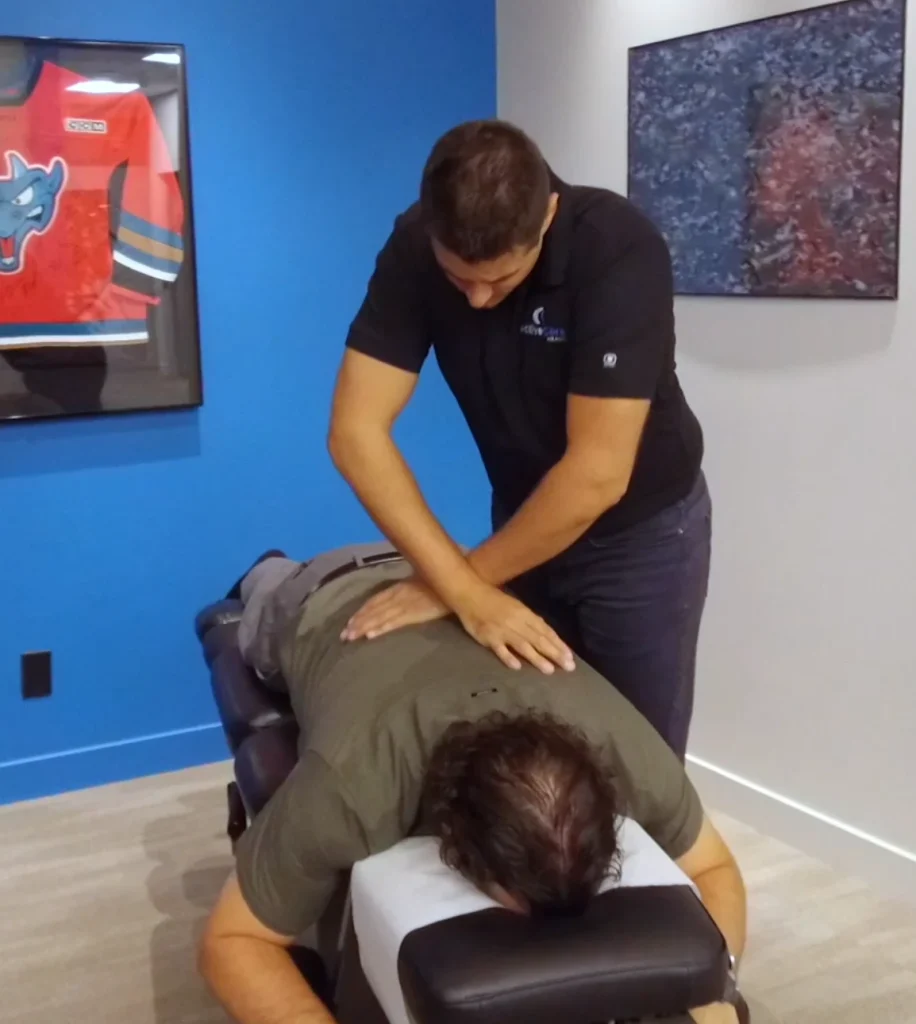
The “Answer” to how long an adjustment lasts is twofold: the chemical phase and the structural phase.
In the first 24 to 48 hours, your body undergoes a chemical shift. We are reducing cytokine production (inflammatory markers) and increasing the flow of cerebrospinal fluid. This is why many patients feel an immediate “lightness” or a reduction in brain fog.
However, the structural “holding” is a matter of neuromuscular re-education. Think of it like orthodontics. A retainer does not move your teeth; it holds them in place so the bone can harden around the new position. A chiropractic adjustment is the “move,” but your lifestyle and follow-up care are the “retainer.” For a healthy individual in Kelowna, a well-delivered adjustment can influence joint mechanoreceptors for weeks. For an active athlete, that window might be shorter due to the physical “noise” of their sport, which is why maintenance is the gold standard for performance.
The Plan: Your Roadmap to Long-Term Stability
At Active Care Health, we do not believe in guesswork. To ensure your adjustments last as long as possible, we follow a structured protocol designed to move you from “Crisis Care” to “Maintenance Care” if that is something you are interested in.
Phase 1: The Reset (Days 1-14)
During this initial phase, our focus is on breaking the pain cycle. We may see you more frequently to “stack” the adjustments. Each visit builds on the last. If we wait too long between sessions in the beginning, the body reverts to its old pattern, and we have to start from zero every time.
Phase 2: The Stabilization (Weeks 3-6)
Once the pain has subsided, we move into stabilization. This is where we introduce specific exercises tailored to the Kelowna lifestyle. If you are a hockey player, this involves lateral stability drills. If you are a golfer, we focus on thoracic rotation. We are essentially “locking in” the alignment by strengthening the muscles that surround the corrected joints.
Phase 3: Maintenance Integration (Monthly)
This is the “Performance” phase. You are no longer in pain, but you want to stay that way. Regular monthly checkups with your Kelowna chiropractors ensure that small structural shifts and misalignments of your spine are caught before they turn into a full-blown injury that keeps you off the ice or the golf course.
Phase 4: The Environmental Audit
We look at your workstation, your skating stride, and even your sleep position. By removing the daily stressors that caused the misalignment in the first place, we extend the life of every adjustment significantly.
The Pitfalls: Why Some Adjustments “Fail” to Hold
It is important to be direct about why some patients do not see the longevity they expect.
· The “Silent” Inflammatory Diet: If you are consuming high amounts of processed sugars and inflammatory oils, your ligaments will remain “lax” and angry. An inflamed body cannot hold a structural correction as well as a “clean” one.
· The Weekend Warrior Syndrome: Many people in Kelowna go from zero activity during the week to extreme mountain biking or hockey on the weekends. This “shock” to the system is the number one cause of why adjustments may not hold. Consistency in movement is the key to spinal health.
· Ignoring the Soft Tissue: You cannot fix a skeletal problem while ignoring the muscles. If you have deep knots (trigger points) that are not being addressed through massage or stretching, those muscles will eventually win the tug-of-war against your spine.
· Dehydration: Discs between your vertebrae are mostly water. When you are dehydrated, they lose height and “cushion,” making the joints more prone to slipping back into a restricted state.
Beyond the Adjustment: Your Path to Peak Performance
Ultimately, the longevity of your chiropractic adjustment is a collaborative effort between your clinical care at Active Care Health and your daily physical habits. While the precision of a Kelowna chiropractor provides the necessary reset for your nervous system, your commitment to proper movement, hydration, and strength training ensures that those corrections stand the test of time. Whether you are aiming for a championship season on the ice or simply want to enjoy a pain free life in the beautiful Okanagan, prioritizing spinal health is a long term investment. We invite you to visit us in Kelowna to develop a personalized plan that keeps you moving at your peak performance for years to come.
Frequently Asked Questions
Can I play hockey immediately after an adjustment?
It is generally recommended to wait at least an hour before high impact activity. This allows the nervous system to settle and the supportive tissues to adapt to the new alignment without the immediate interference of physical trauma.
Will I feel sore after a chiropractic session?
Soreness can occasionally occur and is a normal response similar to what one feels after a workout. It is the result of muscles being stretched and joints moving in ways they have not moved recently. This is often a sign that the body is beginning to heal.
How often should a hockey player see a chiropractor?
During the season, many players benefit from weekly or bi-weekly checkups. This proactive approach allows us to address “micro-traumas” before they become “macro-injuries” that require significant time off the ice.
Does ice or heat help an adjustment last longer?
Ice is typically preferred for the first 24 hours to reduce minor inflammation. This helps the surrounding muscles relax, which assists the spine in maintaining its new position. Heat is better for chronic muscle stiffness later in the recovery process.
Will my adjustment last longer if I stretch?
Yes. Dynamic stretching helps maintain joint mobility and prevents tight muscle groups common in hockey—such as hip flexors and hamstrings—from pulling the pelvis out of alignment and causing recurring lower back issues.