Massage therapy provides a critical physiological intervention for Kelowna transport professionals who experience muscular hypertonicity and restricted blood flow from prolonged seated operations. By addressing myofascial trigger points and promoting lymphatic drainage, these clinical applications mitigate the cumulative physical stress of vehicle vibrations. Targeted soft tissue manipulation restores tissue elasticity and supports the long-term musculoskeletal health of the regional workforce.
Pathophysiology of Soft Tissue Strain in Kelowna Transport Occupations
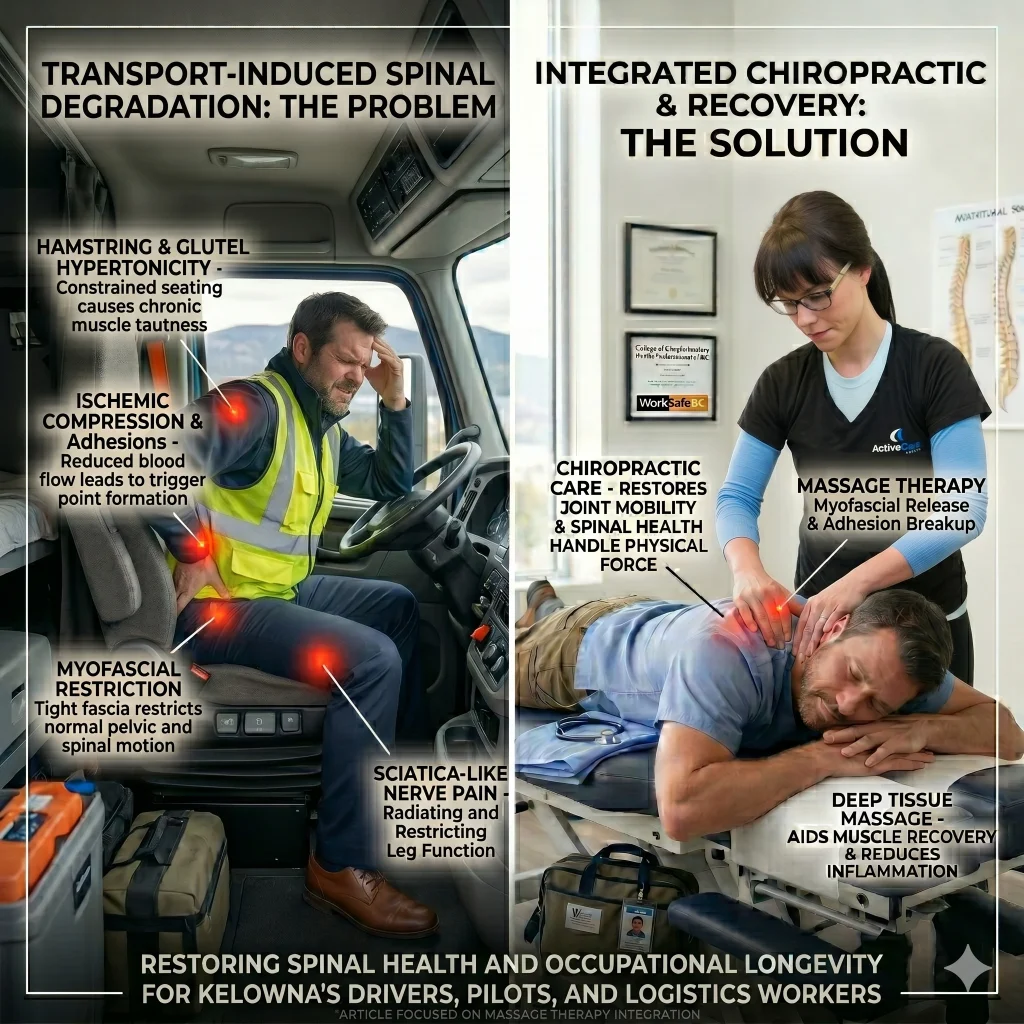
Kelowna functions as a logistical center, requiring pilots, delivery drivers, and long-haul operators to endure extensive shifts in seated positions. These occupations subject the musculoskeletal system to persistent low-amplitude vibrations and static loading. Kelowna Massage Therapy serves as a primary modality to counteract the resulting tissue ischemia and myofascial adhesions that develop in the lumbar and pelvic regions.
Mechanics of Ischemic Compression and Myofascial Restriction
Ischemic compression occurs when prolonged pressure on specific muscle groups restricts blood flow, leading to a localized deficiency of oxygen and nutrients. For individuals in the transport sector, the gluteal and hamstring complexes often remain under constant pressure. This state facilitates the formation of myofascial trigger points – hyperirritable spots within a taut band of skeletal muscle – which can cause referred pain and significant limitations in joint mobility.
Clinical Applications of Manual Soft Tissue Therapy
Manual soft tissue therapy involves the scientific manipulation of the soft tissues of the body for the purpose of normalizing those tissues. For professionals experiencing vehicle-induced vibration, the focus is on reducing the sympathetic nervous system response and improving the structural integrity of the fascia.
- Trigger Point Release – This technique involves applying direct pressure to specific areas of muscle tension to interrupt the pain-spasm cycle.
- Myofascial Release – This method targets the connective tissue fibers, utilizing sustained pressure to eliminate restrictions and restore the fluid nature of the fascia.
- Lymphatic Drainage – Gentle, rhythmic movements assist in the removal of metabolic waste products that accumulate during periods of physical inactivity.
Impact of Vibration on Muscular Tonus
Vibration-induced muscular fatigue is a condition where repetitive mechanical energy causes involuntary muscle contractions. These micro-contractions lead to increased basal muscle tone, or hypertonicity. Over time, this elevated tone results in chronic stiffness and a decreased threshold for injury. Clinical massage interventions work to reset these spindle fibers, allowing the muscle to return to a neutral, resting state.
Technical Framework for Professional Practitioner Selection
Professional standards for integrated health services are maintained by Active Care Health in the Kelowna region to ensure clinical excellence. When selecting a practitioner for Kelowna Massage Therapy or related physical recovery services, transport professionals should utilize this five-point technical evaluation:
- Clinical Assessment Protocol – The provider must perform a baseline assessment of postural alignment and tissue texture.
- Advanced Modality Expertise – Practitioners should demonstrate proficiency in deep tissue, sports, or orthopedic massage techniques specific to occupational strain.
- Integration of Biomechanical Feedback – A professional must incorporate feedback regarding range of motion and functional movement patterns.
- Sanitary and Safety Compliance – The facility must adhere to provincial health regulations regarding equipment sterilization and patient privacy.
- Evidence-Based Treatment Planning – Each session should be part of a documented plan with clear physiological objectives and measurable outcomes.
Conclusion: Systematic Soft Tissue Maintenance for Occupational Longevity
The mitigation of chronic occupational strain for Kelowna transport professionals requires a systematic application of clinical massage therapy. As established, the repetitive mechanical energy of vehicle vibrations and the static loading of prolonged sitting lead to quantifiable tissue degradation and circulatory impairment. By utilizing targeted myofascial release and circulatory restoration, practitioners facilitate the recovery of musculoskeletal integrity and prevent the progression of work-related injuries.
The adherence to professional standards set by the College of Complementary Health Professionals of BC is a critical component of safe clinical practice. Active Care Health ensures that these standards are maintained within the regional health landscape, providing transport workers with evidence-based interventions. Prioritizing regular soft tissue maintenance is essential for sustaining physical performance and ensuring the long-term career viability of pilots, drivers, and delivery personnel in the Kelowna region.